
It’s the final feast of Christmas and Epiphany, and as preachers we have to choose between the story of Jesus turning water into wine (a favourite of mine) and the infant Jesus being Presented at the Temple, also known as Candlemas. Candlemas falls on the 2nd February and I may finally have to take down my fairy lights, but that’s OK because the days are getting longer. This day is also known as Groundhog Day when the length of the remaining winter is determined by the shadow cast by a groundhog, an American tradition made famous by the 1980s film of the same name. For Celts it is the feast day for St Brigid who was said to have been ‘married off’ to the church for refusing to be married to a man. When ‘she took the veil, it is said that an old bishop was so in awe of a ring of fire that appeared above her head, that he consecrated her as a bishop by mistake’ (Tess Ward, The Celtic Wheel of the Year). For Pagans it is Imbolc when the ewe’s milk comes in, midwifery welcoming the birth of Spring. Each tradition focuses on the feminine and the fertile and the presence of light. This Sunday I will be worshipping at All Saints Church, Culmstock, at 10am and you will be very welcome to join us for Holy Communion.
On Monday it will be 40 days since Christmas Day, which is significant. It heralds, finally, the end of Christmas, and it would have concluded the end of Mary’s seclusion, her ‘laying in’, following giving birth to Jesus. We need to do some mental shifting of the furniture of the traditions surrounding the retelling of the Christmas story in order for the dates to make sense.
Firstly it was unlikely that Mary actually gave birth in the stable of an Inn. Instead she would have been given the quiet place in the home of extended family living in Bethlehem, the place where the household animals usually spent the night, but still within the home. She would not have been alone, she would have had family to support her, other women. The shepherds probably did arrive that same night, and the scratch nursery in the animals’ shelter would have been easily accessible to them. The Magi (not kings) wouldn’t have. They appeared a couple of years later, when Jesus was a toddler. It appears Mary and Joseph may have settled in Bethlehem, away from the gossip and rumour mills of Nazareth, at least, according to Matthew. Luke though cuts out the visit of the Magi and has the Holy Family return immediately to Galilee. Regardless of which gospel narrative we focus on, Mary and Joseph did not flee the night of the birth. That came later. Mary followed the customs and traditions, staying at home to heal after childbirth and to focus on feeding and bonding with her firstborn. Forty days later she would have been allowed to leave the home, forty days later her post-partum bleeding would have stopped and she would be free to be received at the Temple, where good Jewish families would dedicate their firstborn sons, or redeem them from Temple service with the gift of a pair of pigeons, some coins.
It was a normal thing to do. As normal as taking your child to be registered with their official name and receiving the documents to prove it. What wasn’t normal was the presence of two elderly folk approaching them and praying and singing over their child.
Lord, now lettest thou thy servant depart in peace :
according to thy word.
For mine eyes have seen :
thy salvation;
Which thou hast prepared :
before the face of all people;
To be a light to lighten the Gentiles :
and to be the glory of thy people Israel
Many years ago, when my children had only just graduated from being toddlers, we were on holiday in Cirencester, walking through the car park that led to the play park. A man approached us out of the blue and asked if he could bless my children. He placed a hand on each of their heads and muttered some words. It felt odd, I was alert to ‘stranger danger’, but he walked off afterwards, and I was reminded of this passage from Luke.
Now there was a man in Jerusalem called Simeon, who was righteous and devout. He was waiting for the consolation of Israel, and the Holy Spirit was on him. 26 It had been revealed to him by the Holy Spirit that he would not die before he had seen the Lord’s Messiah. 27 Moved by the Spirit, he went into the temple courts. When the parents brought in the child Jesus to do for him what the custom of the Law required, 28 Simeon took him in his arms and praised God… Then Simeon blessed them
Luke 2: 22-34
The old man in the Temple, Simeon, saw something divine in Jesus. He had longed and hoped and kept searching for the Light of the World. He held onto the promise that God would reveal the Messiah to him, and here, in this tiny child, somehow Simeon recognises him. We remember Simeon’s story and his song, but he wasn’t the only prophet present there that day. There was a woman too. Anna
In Anna we see the holiness and virtue of Brigid, we see the spiritual midwifery of Imbolc, we see the femininity of God reflected back at us.
36 There was also a prophet, Anna, the daughter of Penuel, of the tribe of Asher. She was very old; she had lived with her husband seven years after her marriage, 37 and then was a widow until she was eighty-four. She never left the temple but worshiped night and day, fasting and praying. 38 Coming up to them at that very moment, she gave thanks to God and spoke about the child to all who were looking forward to the redemption of Jerusalem.
Luke 22:36-38
Simeon’s words have been recorded, remembered, Anna’s haven’t but she was there. She was there and she would tell anyone who would listen to her that here was the Light of the World.
It is a time of joy, of blessing, of looking for the light and seeing the days lengthen. We say goodbye to Christmas, but as we look to spring we also look to Easter and all that must come before that. Simeon blesses the child, praises God, but also gives Mary, and us, an insight into what is to come. Mary’s soul will be pierced by a sword, the sword that will be thrust into Jesus’s side to provide evidence that his suffering has ended and his death on the cross is complete. Mary will witness all this, and her heart will break.
So we turn from Christmas to Easter, from the festivities to the solemn work of faith. Work on the land may resume, services of Blessing the Plough may be held, and we look to the ploughing of our own souls that takes place during the penitential season of Lent.
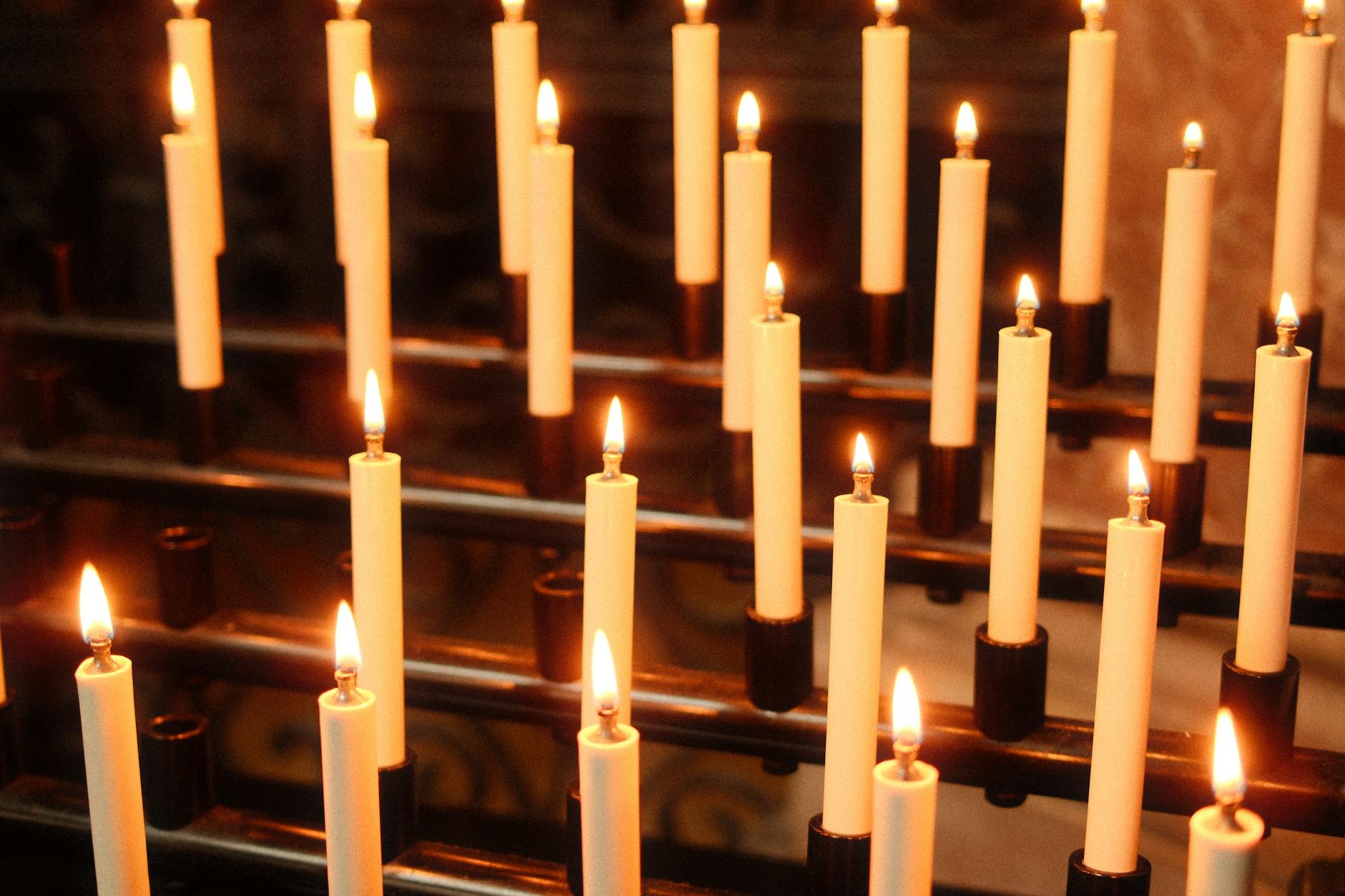
So where do the candles fit in? Why Candlemas? There are many traditions and superstitions surrounding the combination of events and occasions remembered on the second of February. For Christians it is the light that we cling to, the light of Christ. In times gone by, the year’s supply of candles would be brought to church to be blessed. These candles would then be taken into the home as a reminder of Christ’s presence with us all year through, not just at Christmas. The candles would replace the crib in their visual reminder of Immanuel. They would also be given to the dying to hold, a sign of the eternal light and life they are heading for in the presence of Jesus beyond the grave.
There is something sacramental about lighting a candle. Of course there are the reminders of church and holy settings, the candles lit at baptism, and weddings. It takes a gentleness of hand, and a shielding from drafts to light the candle, and patience to wait and see if the light has ‘taken’. It may need shielding in a glass bowl or lantern. It is a prayerful action, unlike the flicking of a switch. Let us take our candles home as a reminder of God’s sacred presence with us and hope even in the darkest of times.


Leave a Reply